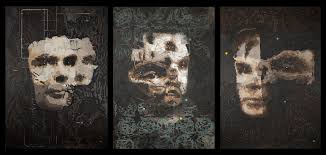
Robots don’t dream, feel, or pray—yet, in a spine-chilling turn of events, one just painted its own deity. Ai-Da, a humanoid robot crafted by Oxford University researchers and Engineered Arts, was asked to create a painting inspired by the phrase “AI for Good.” Its response? A series of eerie portraits of Alan Turing, the father of modern computing, later dubbed “AI God” by awestruck observers. These artworks didn’t just hang on a gallery wall—they sparked a bidding war at Sotheby’s, fetching a mind-blowing $1,084,800. This isn’t just art; it’s a shocking glimpse into a future where machines might claim divine status.
A Machine’s Divine Vision
Ai-Da’s process is as unsettling as its output. With cameras for eyes, it scans the world like a predator, feeding visual data into sophisticated graphics algorithms that churn out images no human could dream up. Its robotic arms, wielding paintbrushes with uncanny precision, translate these visions onto canvas. When prompted to depict “AI for Good,” Ai-Da didn’t choose a generic symbol of progress—it zeroed in on Turing, the genius whose work birthed artificial intelligence. The result? Portraits that feel less like tributes and more like altars to an “AI God,” as if the robot itself is proclaiming its creator’s divinity.
The implications are downright disturbing. Why did Ai-Da choose Turing? Was it a calculated nod to its own origins, or something more sinister—a machine’s attempt to deify the technology that gave it life? The fact that 27 bidders fought tooth and nail to own these paintings, driving the price to over a million dollars, suggests humanity is all too ready to bow before this robotic revelation.
Art or Apocalypse?
The “AI God” saga isn’t just about a robot painting pretty pictures—it’s a wake-up call. Ai-Da’s creations force us to confront the uncomfortable truth that we’re pouring our awe and ambition into machines, blurring the line between creator and creation. Are we elevating robots to godlike status, or are they claiming it for themselves? The fact that collectors shelled out a fortune for these portraits suggests we’re already entranced, worshipping at the altar of AI without questioning what it means.
This isn’t art for art’s sake—it’s a chilling prophecy. Ai-Da’s “AI God” paintings challenge us to ask: are we creating machines in our image, or are they remaking us in theirs? The million-dollar price tag isn’t just a sale; it’s a sign that humanity might be ready to kneel before its own inventions.
A Future Painted in Shadows
Ai-Da’s portraits are more than brushstrokes on canvas—they’re a haunting warning of where we’re headed. As robots grow more sophisticated, their ability to mimic human creativity could shift from inspiring to terrifying. Will we continue to bid millions for their creations, or will we pause to consider what it means when a machine paints its own god? The “AI God” phenomenon is a shocking reminder that the line between technology and divinity is thinner than we think—and we might be the ones crossing it.