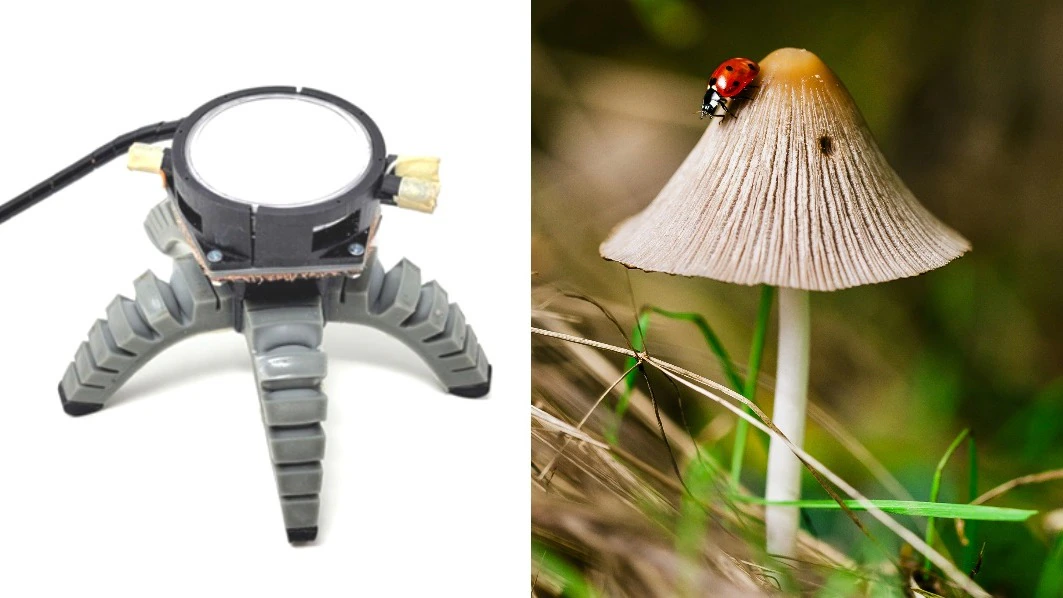
A team from Cornell University and the University of Florence has conducted a study involving a biohybrid robot controlled by fungal mycelium. The research, published in Science Robotics, explores how electrical signals generated by the mycelium of a king oyster mushroom (Pleurotus eryngii) can be used to operate a robot. The experiment involved integrating mycelium into the robot’s electronic system to serve as a control mechanism.
Technical Setup and Operation
The robot, designed with a starfish-like structure, responds to electrical impulses from the mycelium. Fungi, including the king oyster mushroom, produce electrophysiological signals in response to environmental stimuli, such as light. In this case, researchers exposed the mycelium to ultraviolet (UV) light, which triggered electrical activity. This activity was captured by an electrical interface designed to filter out vibrations and electromagnetic interference, ensuring accurate signal processing. The processed signals were then converted into commands for the robot’s actuators, causing its legs to move.
Two types of robots were tested: a soft, starfish-shaped model and a wheeled version. In experiments, UV light exposure prompted the mycelium to generate signals that altered the robots’ movements, such as changing their gait or speed. The system also allowed researchers to override the mycelium’s natural signals with external inputs, demonstrating potential for controlled operation.
Potential Applications
The researchers suggest that this technology could be applied in agriculture to monitor soil chemistry. The mycelium’s sensitivity to environmental changes, such as variations in soil composition, could enable robots to detect and respond to conditions like nutrient deficiencies or contaminants. For example, such robots might adjust fertilizer application to optimize crop growth and reduce environmental impacts, such as algal blooms. The choice of king oyster mushroom mycelium was due to its ease of cultivation and resilience in harsh conditions, which could make it suitable for real-world deployment.
Broader Context and Limitations
This study builds on prior work in biohybrid robotics, which integrates living organisms with mechanical systems. While the use of fungal mycelium is novel, the technology remains in early stages, with practical applications still theoretical. Challenges include maintaining clean mycelium cultures to avoid contamination and ensuring long-term functionality in dynamic environments like agricultural fields. The research was supported by the National Science Foundation and the U.S. Department of Agriculture’s National Institute of Food and Agriculture.
Conclusion
The integration of fungal mycelium into robotic systems represents a technical advancement in biohybrid robotics. By leveraging the natural responsiveness of mycelium to environmental stimuli, researchers have demonstrated a method for controlling robot movement. While the experiment is a step toward autonomous systems for agricultural monitoring, further development is needed to address practical challenges and scale the technology for real-world use.