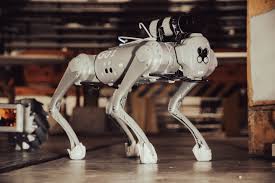
Nestled beneath the Franco-Swiss border, the Large Hadron Collider (LHC) is a scientific wonder, a 27-kilometer ring of superconducting magnets that smashes protons together at nearly the speed of light, unraveling the mysteries of the universe. From the discovery of the Higgs boson to probing quark-gluon plasmas, the LHC is a beacon of human curiosity. But its brilliance comes with danger—ionizing radiation that makes certain areas off-limits to humans. Enter the CERNquadbot, or “Robodog,” a four-legged robotic marvel crafted by CERN’s engineers to patrol these hazardous zones with unwavering courage and precision. This isn’t just a robot—it’s a guardian of science, and it’s earning every bit of our admiration.
A Nimble Hero in a Hostile World
The LHC’s experimental caverns, like those housing the ALICE detector, are a maze of loose wires, pipes, and uneven surfaces—terrain that’s treacherous for humans and impassable for wheeled robots. But the Robodog, developed in CERN’s Building 937, is built for this challenge. With its quadruped locomotion, inspired by the likes of Boston Dynamics’ Spot, it nimbly navigates cluttered spaces, climbs stairs, and scurries under beamlines where no robot has ventured before. “There were no issues at all: the robot was completely stable throughout the inspection,” said Chris McGreavy, a robotics engineer in CERN’s Controls, Electronics and Mechatronics group, after the Robodog’s first successful radiation protection test in the North Area.
Equipped with advanced sensors and cameras, the Robodog autonomously monitors for fires, water leaks, and other hazards that could disrupt the LHC’s operations. Its ability to detect environmental anomalies in real time is a lifesaver, ensuring the safety of CERN’s staff and the integrity of its experiments. This robotic guardian doesn’t just perform tasks—it complements CERN’s fleet of robots, like the Train Inspection Monorail (TIM), which patrols the LHC’s tunnels from above. Together, they form a dynamic duo, with TIM covering vast distances and the Robodog diving into the nitty-gritty below.
Engineering Excellence in Action
The Robodog’s debut is a triumph of engineering ingenuity. Built on a commercially available platform like Unitree’s Go1, it’s being enhanced with custom tools and advanced control algorithms to tackle the LHC’s unique challenges. CERN’s team is already developing successors to deploy in complex environments like the ALICE detector’s cavern, with its metal stairs and narrow corridors. These future Robodogs will carry out regular inspections, swiftly identifying issues that could halt experiments, all while reducing human exposure to radiation. “They can identify water or fire leaks and other incidents, such as false alarms, in a timely manner,” McGreavy noted, highlighting their critical role in maintaining the LHC’s operations.
What makes the Robodog truly remarkable is its synergy with CERN’s robotic ecosystem. While TIM glides along ceiling rails for long-distance monitoring, the Robodog scurries through cramped, cluttered spaces, accessing areas that were previously out of reach. This complementary approach maximizes efficiency, ensuring no corner of the LHC goes unchecked. It’s a shining example of how CERN’s engineers are crafting solutions tailored to the world’s most advanced scientific facility.
A Bright Future for Science and Safety
The Robodog’s successful radiation protection test in CERN’s North Area is just the beginning. As CERN prepares for the High Luminosity LHC upgrade, set to boost discovery potential by 2027, the Robodog and its successors will play a pivotal role in keeping the facility safe and operational. Their ability to navigate hazardous environments not only protects human workers but also accelerates scientific progress by minimizing downtime. From monitoring radiation levels to spotting potential disasters, these four-legged heroes are proving that robotics can go where humans cannot, all while advancing our understanding of the universe.
The CERN quad bot is more than a technological feat—it’s a symbol of human creativity and resilience. By blending cutting-edge robotics with the pursuit of scientific truth, CERN has given us a robot that’s as inspiring as the discoveries it helps protect. Here’s to the Robodog, a four-legged pioneer trotting boldly into the future of particle physics, keeping the LHC’s mysteries safe for us all to explore.