Agricultural Drones in India: Shipping Hardware, Deployment Realities, and Market Pricing

Market Landscape and Regulatory Framework
The Indian agricultural drone market has transitioned from experimental pilots to commercial service operations, driven by DGCA certification pathways, state subsidy schemes, and rising labor costs in rural farming regions. The regulatory environment requires UAS Operator Licenses, Remote Pilot Certificates, and type certification for drones carrying payloads exceeding certain thresholds. Agricultural drones fall under the DGCA's specific category for unmanned aircraft systems used for spraying, seeding, and monitoring. Compliance demands geofencing, telemetry logging, and adherence to the 120-meter altitude ceiling unless special permissions are granted for precision agriculture operations.
Hardware grading in this sector follows a strict hierarchy: shipped and field-tested platforms lead, followed by documented pilot deployments with agronomic data, and finally manufacturer announcements or roadmaps. The domestic supply chain remains heavily reliant on imported flight controllers, brushless motors, and lithium-polymer battery cells, though local assembly and firmware localization are increasing. Service providers dominate adoption, while direct farm ownership remains limited by capital expenditure and maintenance complexity.
DJI Agras Series: Shipping Hardware and Indian Availability
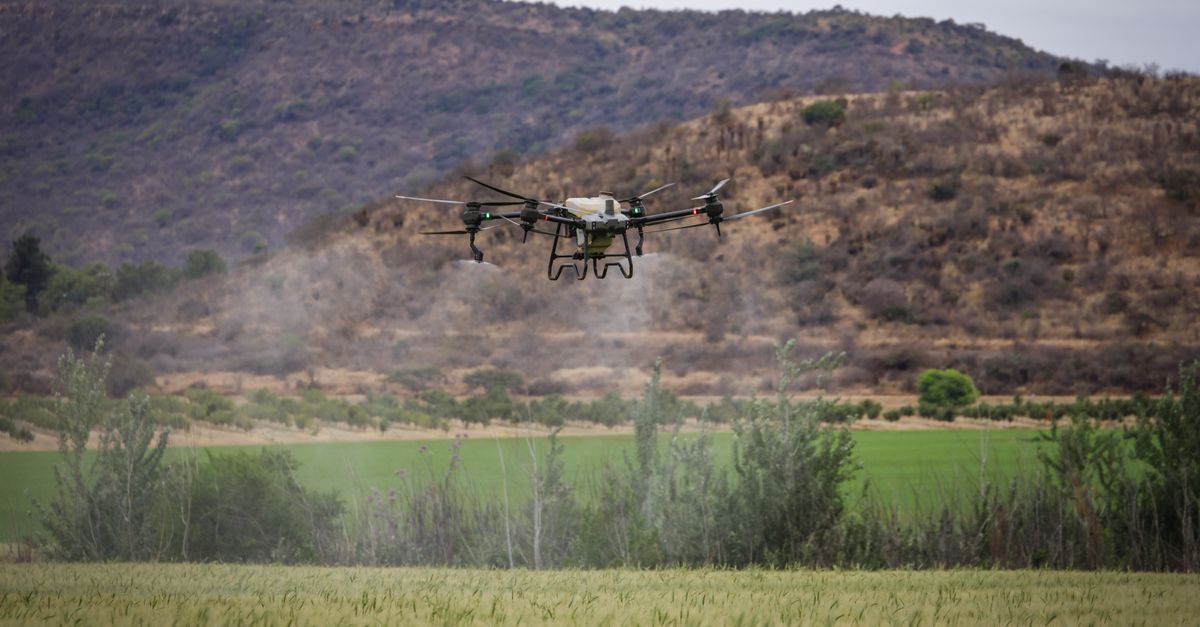
DJI's Agras line represents the highest volume of shipping hardware in India's agricultural drone segment. The T40 and T50 models are widely available through authorized distributors across Punjab, Haryana, Uttar Pradesh, Karnataka, and Andhra Pradesh. Both platforms ship with integrated centrifugal spray systems, RTK positioning modules, and obstacle avoidance arrays. DJI's manufacturing footprint includes facilities in Shenzhen and long-term assembly partnerships in India, which has reduced import duties on fully built units while increasing local component sourcing.
Agras T40 and T50 Specifications
The Agras T40 features a 40-liter spray tank, 10-kilogram payload capacity, and a maximum flight time of approximately 15 minutes under full load. It utilizes a four-rotor configuration with dual-battery hot-swapping, enabling continuous operation during extended spraying missions. The T50 upgrades the tank to 50 liters, payload to 25 kilograms, and introduces a dual-pump spraying system with adjustable flow rates between 0.5 and 4.0 liters per minute. Both models support variable-rate application, GPS-guided path planning, and real-time telemetry via the DJI Agras app. Independent field reports confirm spray uniformity within 85-92% across flat terrain, with performance degradation noted on slopes exceeding 15 degrees due to drift and battery discharge rates.
Pricing and Deployment Status in India
DJI Agras hardware ships directly to India through authorized distributors. The T40 is priced between ₹12,00,000 and ₹14,50,000 depending on configuration, warranty terms, and regional GST. The T50 ranges from ₹18,00,000 to ₹22,00,000. These figures represent landed cost estimates inclusive of standard import duties, distributor margins, and basic training packages. Battery packs, spare nozzles, and replacement motors are sold separately. Deployment data from state agriculture departments and FPO networks indicates that over 18,000 DJI Agras units are actively registered with DGCA for agricultural use, with service providers accounting for approximately 70% of operational hours. Direct farm ownership remains below 15% due to capital constraints and maintenance requirements.
Garuda Aerospace: Domestic Platforms for Agri and Cargo
Garuda Aerospace, headquartered in Bengaluru, has established itself through cargo and defense drone deployments, with agricultural variants emerging as a secondary commercial application. The company's platforms prioritize payload flexibility, modular airframes, and DGCA-compliant telemetry. Unlike consumer-focused agricultural drones, Garuda's agri configurations are built around heavy-lift multirotor architectures designed for consistent performance in high-temperature environments and long-range logistics corridors.
Garuda's agricultural deployments have primarily served pilot programs with state logistics missions, pharmaceutical supply chains, and large-scale plantation monitoring. The company's hardware grading places it in the pilot deployment tier for agriculture, with limited commercial service contracts compared to DJI's volume. Factory videos and on-stage demonstrations confirm successful spray and seeding trials, but widespread farmer adoption remains constrained by service network coverage and spare parts availability outside Karnataka and Tamil Nadu. Garuda's pricing for custom agri configurations typically starts at ₹25,00,000, reflecting specialized engineering and lower production scales.
Indian Agri-Drone Startups: Hardware and Pilot Data
Domestic startups have focused on certified hardware, localized firmware, and service-oriented business models. The sector is characterized by fragmented production, reliance on imported core components, and varying degrees of DGCA type certification.
IdeaForge and Agri Drone India
IdeaForge Technology has manufactured the Skyflyer series, which includes agricultural variants approved by the DGCA for spraying and seeding. The company's hardware ships with indigenous flight control systems, modular battery architectures, and compliance with Indian telecommunication standards. IdeaForge's agri platforms are graded as shipping hardware with verified pilot deployments in Maharashtra, Gujarat, and Rajasthan. Independent reports note reliable performance in low-altitude monitoring and precision application, though payload capacity and spray uniformity lag behind DJI's T40/T50 benchmarks. Pricing ranges from ₹8,50,000 to ₹11,00,000 for base configurations.
Agri Drone India operates as a service provider and hardware integrator, partnering with domestic manufacturers and DJI distributors to offer contract spraying, crop health monitoring, and FPO training programs. The company's deployment data shows active operations across Punjab, Haryana, and Telangana, with documented coverage exceeding 50,000 hectares annually. Hardware grading for Agri Drone India falls under pilot deployments and service contracts, as the company does not manufacture airframes but aggregates and maintains third-party platforms.
Commercial Service Providers and FPO Adoption
Farmer Producer Organizations (FPOs) and custom hiring centers dominate agricultural drone adoption in India. Service rates typically range from ₹250 to ₹400 per hectare, depending on crop type, terrain, and application volume. FPOs prefer service models over direct ownership due to maintenance complexity, battery degradation, and regulatory compliance requirements. Deployment data from state agriculture departments indicates that service providers cover approximately 65% of India's mechanized agricultural drone operations, with remaining capacity split between direct farm purchases and corporate plantation contracts.
Procurement, Maintenance, and Operational Costs
Acquiring agricultural hardware in India requires budgeting beyond the base unit price. Landing costs include DGCA registration fees, Remote Pilot training, insurance premiums, and spare parts reserves. Battery lifecycle remains the primary operational expense, with lithium-polymer packs requiring replacement every 300-400 cycles. Local service centers charge ₹15,000 to ₹25,000 per battery replacement, while motor and pump maintenance adds ₹8,000 to ₹12,000 annually per unit.
Regulatory compliance demands annual UAS Operator License renewals, telemetry data retention, and periodic safety audits. State subsidy schemes in Punjab, Haryana, and Karnataka offset 40-50% of hardware costs for FPOs and registered farmers, though disbursement delays and documentation requirements remain operational bottlenecks. Independent reporting confirms that total cost of ownership over three years ranges from ₹18,00,000 to ₹28,00,000 per unit, depending on usage intensity and maintenance frequency. Service providers achieve break-even within 18-24 months under consistent contract volumes, while direct farm operators require 3-4 years to amortize capital expenditure.
References
- DJI Agras Official Specifications and Product Pages. https://www.dji.com/agras
- DGCA Type Certification and UAS Operator Guidelines for Agricultural Drones. https://dgca.gov.in
- Garuda Aerospace Press Releases and Platform Documentation. https://garudaaerospace.com
- IdeaForge Technology Skyflyer Series Certifications and Dealer Networks. https://ideaforge.in
- Agri Drone India Service Deployment Reports and FPO Partnerships. https://agridroneindia.com
- State Agriculture Department Subsidy Schemes and Mechanization Data (Punjab, Haryana, Karnataka). https://agriculture.gov.in
- Independent Field Trials and Spray Uniformity Reports by ICAR-CSSF. https://cssf.res.in
✓ Key takeaways
- •Hands-on view of Agricultural Drones in India: Shipping Hardware, Deployment Realities, and Market Pricing inside our Agricultural Drones library.
- •Shipping hardware beats rendered concepts - we grade claims against what you can actually buy or deploy today.
- •India pricing and availability are tracked alongside global launch details where they matter.
References
- DJI Agras Official Specifications and Product Pages
- DGCA Type Certification and UAS Operator Guidelines for Agricultural Drones
- Garuda Aerospace Press Releases and Platform Documentation
- IdeaForge Technology Skyflyer Series Certifications and Dealer Networks
- Agri Drone India Service Deployment Reports and FPO Partnerships
- State Agriculture Department Subsidy Schemes and Mechanization Data
- Independent Field Trials and Spray Uniformity Reports by ICAR-CSSF
Related articles
More in Agricultural Drones →