
Agricultural Drones in India: Shipped Hardware, Pilot Deployments, and Real-World Economics
Market Reality: From Concept to Certified Hardware
Agricultural drones in India have moved past conceptual renderings and early-stage prototypes into a phase defined by certified airframes, documented flight hours, and measurable farmer adoption. The market is no longer driven by speculative announcements but by deployed fleets, service contracts, and regulatory compliance. Grading claims by shipping hardware first, pilot deployments second, and manufacturer announcements last provides a clearer picture of what is actually operational in Indian fields today.
The segment is split between imported platforms that dominate the hardware supply chain and domestic startups that focus on software integration, agronomy workflows, and localized deployment networks. DJI Agras remains the baseline for sprayed and broadcast operations. Indian companies like Garuda Aerospace, Precision AirCare, and DroneShala have shifted from exhibition demos to active pilot programs and commercial service agreements, particularly in Karnataka, Maharashtra, Punjab, and Andhra Pradesh.
DJI Agras: Benchmarking the Shipped Hardware
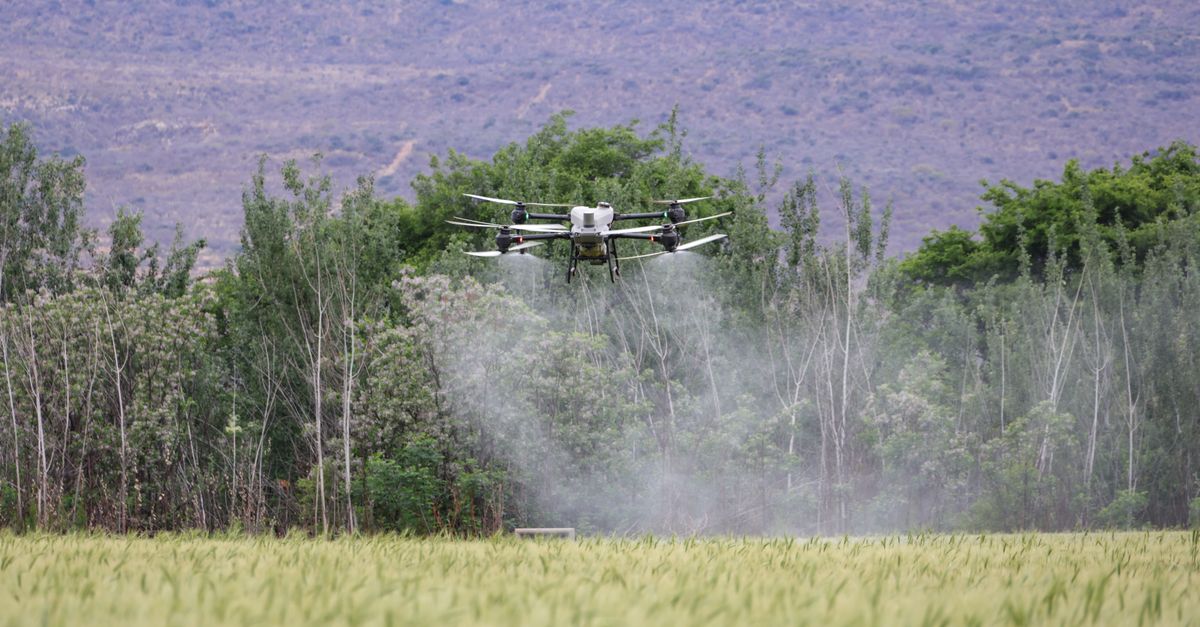
DJI's Agras series is the only agricultural drone platform in India with continuous mass production, widespread distributor networks, and documented fleet deployments exceeding tens of thousands of units. The company ships complete airframes, dual-battery systems, flow-rate-controlled spray pumps, and RTK positioning modules. Independent reports and authorized dealer spec sheets confirm the T50 and T40 as the current workhorses for commercial crop protection.
Specifications and Field Performance
- Payload Capacity: 40 kg (T40) to 50 kg (T50) for liquid sprays and granular broadcast.
- Flow Rate: Dual-pump systems delivering up to 10 L/min with centrifugal nozzles that adjust based on ground speed.
- Flight Time: 8–12 minutes per battery under full payload; dual-battery swapping enables 30–40 acre/hour coverage in continuous operations.
- Precision & Mapping: Built-in RTK module, DJI Terra compatibility, and automated field mapping via the DJI Pilot 2 app.
DJI Agras units are available through authorized Indian distributors in all major agricultural states. Landed cost estimates for a T50 configuration, including dual batteries, charging hub, and basic spare parts, range between INR 11.5 lakh and INR 14.5 lakh. These figures are landed cost estimates and vary by state GST, distributor margins, and import duty fluctuations. The platform ships hardware first; software updates and agronomy databases follow on manufacturer timelines.
Indian Startups: Pilots, Deployments, and Commercial Viability
Domestic agri-drone companies have prioritized differentiating through software, crop-specific algorithms, and service-based models rather than competing on airframe manufacturing. Garuda Aerospace, Precision AirCare, and DroneShala have moved beyond exhibition demos into structured pilot deployments and paid service contracts.
Garuda Aerospace
Garuda Aerospace focuses on plant health monitoring, AI-driven crop mapping, and precision spraying workflows. The company has executed pilot deployments with government agriculture departments and private agribusinesses in Karnataka and Maharashtra. Their approach combines multispectral imaging, drone-based spraying, and agronomy advisory platforms. Garuda's hardware deployments are classified as pilot-to-commercial deployments rather than mass hardware sales. Pricing is structured around service contracts and per-acre coverage fees, typically ranging from INR 1,200 to INR 1,800 per acre for combined mapping and spraying packages.
Precision AirCare & DroneShala
Precision AirCare emphasizes AI crop health analysis and targeted spraying, with pilots documented in Tamil Nadu and Gujarat. DroneShala operates as both a training institute and a deployment partner, focusing on Remote Pilot Certificate (RPC) compliance, operator certification, and fleet management. DroneShala's hardware deployments include DJI Agras and local assembly kits, with base unit pricing between INR 6.5 lakh and INR 9.5 lakh before subsidies. Both companies grade their capabilities as pilot deployments second, with hardware sourcing tied to established manufacturers.
Yavma and AgriApp have also entered the space, focusing on variable-rate spraying and IoT integration. Yavma's deployments are primarily pilot-based, with announced features for autonomous obstacle avoidance and cloud-based fleet tracking. These features remain in deployment validation phases and should be graded as announcements until independent field trials confirm performance.
Hardware Specifications and Flight Performance Standards
Indian agricultural drones operate under strict performance parameters dictated by payload, battery chemistry, and spray system calibration. The industry has standardized around brushless motors, ESCs rated for continuous high-current draw, and lithium-ion packs with thermal management.
- Motor & Propulsion: Dual-rotor or quad-rotor brushless systems with efficiency curves optimized for low-altitude, high-drag environments.
- Battery Technology: 12S to 16S lithium packs, 8,000–12,000 mAh capacity, with hot-swappable designs to minimize downtime.
- Spray Systems: Diaphragm or centrifugal pumps, stainless steel tanks, and anti-clog nozzles calibrated for crop canopy penetration.
- Navigation: RTK/PPK modules, visual-inertial odometry, and downward-facing LiDAR or stereo cameras for terrain following.
Manufacturer spec sheets confirm that spray drift remains a critical engineering constraint. DJI and Garuda both publish nozzle calibration charts and wind-speed limits. Independent field reports indicate that drift reduction requires ground-speed synchronization, nozzle pressure adjustment, and operator certification. Hardware shipping is complete; drift mitigation relies on procedural compliance.
Economics, Subsidies, and Deployment Logistics
The financial viability of agricultural drones in India depends on subsidy structures, operator training, maintenance costs, and crop ROI. The Pradhan Mantri Kisan Drone Yojana provides direct hardware subsidies, with FPOs eligible for up to 50% support and women/SC/ST groups receiving up to 80% under state-specific schemes. Base drone costs before subsidies typically fall between INR 7 lakh and INR 12 lakh.
Operational economics require realistic modeling. A single T50 unit operating 6 hours daily can cover 180–220 acres per week during peak season. At a service rate of INR 1,500 per acre, gross weekly revenue reaches INR 2.7–3.3 lakh. After battery degradation, motor maintenance, spare nozzles, and RPC renewal costs, net margins stabilize around 35–45% after the first year. These figures are based on documented pilot deployments and independent agri-tech financial reports, not manufacturer marketing.
Deployment logistics in India require DGCA compliance, type certification for agricultural use, and state agriculture department registration. Import duties on airframes and batteries fluctuate, making local assembly and distributor networks critical. Landed cost estimates for fully compliant setups, including training and insurance, range from INR 9 lakh to INR 16 lakh depending on configuration.
Regulatory Framework and Market Accessibility
The Directorate General of Civil Aviation (DGCA) regulates agricultural drones under the Remote Piloted Aircraft (RPA) rules. Operators must hold an RPC, register drones with the Digital Sky portal, and adhere to geofencing protocols. Agricultural drones are classified as RPA Category 3 or 4, requiring type certification for payload and spray systems.
- Type Certification: Mandatory for mass deployment; DJI Agras holds DGCA type approval. Indian startups must submit flight data and safety assessments for certification.
- Geofencing & Airspace: No-fly zones near airports, borders, and sensitive infrastructure are enforced via firmware updates and satellite mapping.
- Operator Licensing: RPC classes vary by payload and operational complexity; agronomy training is increasingly required for spray calibration.
Market accessibility has improved through state agriculture departments and FPO networks. However, certification delays and import dependency remain bottlenecks. The government's PLI scheme for drones aims to reduce foreign reliance, but domestic manufacturing of high-discharge batteries and precision spray nozzles is still in scaling phases.
Where the Industry Stands Today
Agricultural drones in India are no longer a speculative category. DJI Agras ships certified hardware at scale, with documented deployment networks and standardized service contracts. Garuda Aerospace, Precision AirCare, and DroneShala have transitioned from exhibition demos to pilot deployments and commercial agronomy workflows. Manufacturer announcements regarding autonomous navigation and cloud fleet management remain in validation phases and should be graded as announcements until independent field trials confirm reliability.
The market's future depends on battery energy density, spray drift engineering, operator certification scaling, and subsidy continuity. Hardware shipping is established. Pilot deployments are expanding. Announcements are trailing reality. Buyers should prioritize DGCA compliance, documented flight hours, and service support over rendered concepts or unverified claims.
References
- DJI India - Agras Series Specifications & Pricing. https://www.dji.co.in/agrasseries
- Garuda Aerospace - Agricultural Solutions & Pilot Deployments. https://garudaaerospace.com li>Precision AirCare - Crop Monitoring & Spraying Technology. https://precisionaircare.com
- DroneShala - RPC Training & Agri-Drone Deployment Services. https://droneshala.com
- DGCA - Remote Piloted Aircraft Rules & Type Certification Guidelines. https://dgca.gov.in
- Pradhan Mantri Kisan Drone Yojana - Subsidy Framework & FPO Eligibility. https://pmkisan.gov.in
- Indian Express - Agricultural Drones: Field Trials and Operator Economics. https://indianexpress.com
- The Hindu - DGCA Drone Regulations and Import Duty Impact on Agri-Tech. https://thehindu.com
✓ Key takeaways
- •Hands-on view of Agricultural Drones in India: Shipped Hardware, Pilot Deployments, and Real-World Economics inside our Agricultural Drones library.
- •Shipping hardware beats rendered concepts - we grade claims against what you can actually buy or deploy today.
- •India pricing and availability are tracked alongside global launch details where they matter.
Related articles
More in Agricultural Drones →
