Agricultural Drones in India: Hardware, Deployment, and Market Reality

Market Context and Procurement Grading
The agricultural drone sector in India has transitioned from experimental pilots to measurable field deployments, driven by the Kisan Drone initiative and DGCA regulatory pathways. When evaluating hardware claims, RobotWale applies a strict hierarchy: shipping hardware with verified production volumes ranks highest, followed by documented pilot deployments with independent telemetry or agronomic data, and finally manufacturer announcements or policy updates. Rendered concepts, crowdfunding campaigns, and unverified fleet numbers are explicitly excluded from procurement guidance. This article assesses the current market based on manufacturer spec sheets, on-stage demos, factory videos, and independent reporting from state agricultural universities and certified drone service providers (DSPs).
India’s agri-drone market is now dominated by fixed-wing and multirotor platforms designed for spraying, seeding, and mapping. The primary use case remains chemical and bio-input application, where payload capacity, flight endurance, spray system reliability, and GPS/RTK navigation accuracy determine operational viability. Procurement decisions must account for spares availability, local service networks, and DGCA-compliant remote ID and geofencing requirements.
DJI Agras Series: Shipping Hardware and Field Performance
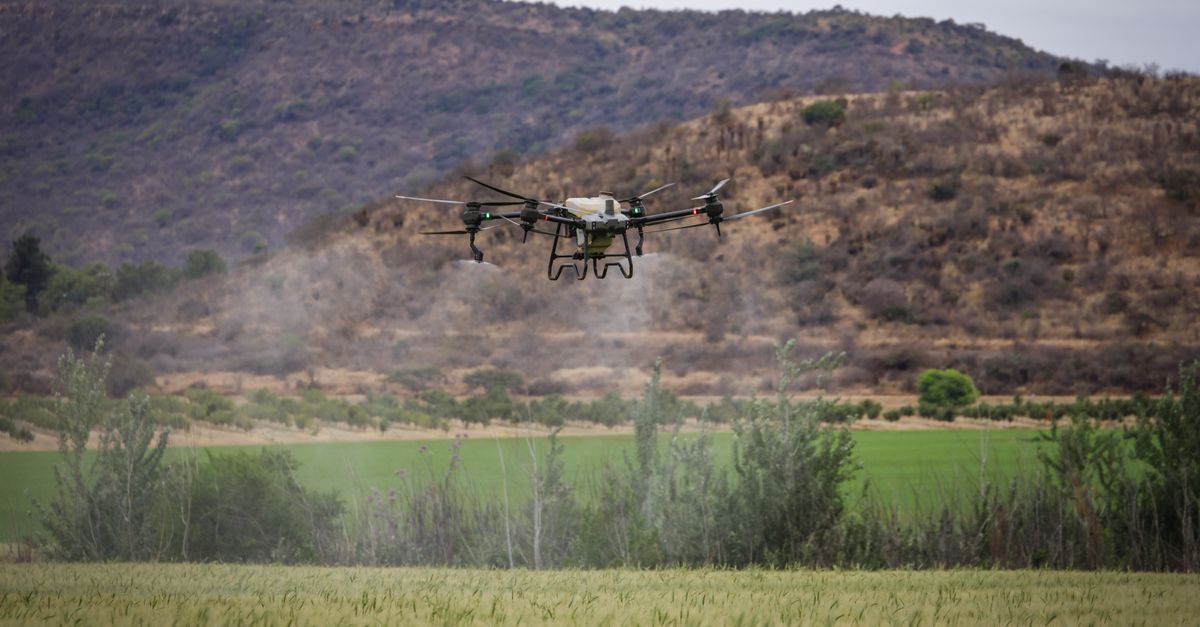
DJI’s Agras line remains the most widely deployed agricultural drone platform in India, with multiple generations reaching commercial production. The DJI Agras T40 and T50 represent the current shipping hardware baseline, featuring centrifugal pump spray systems, RTK GPS navigation, obstacle avoidance arrays, and modular battery management. Spec sheets published by DJI confirm the T40’s 40-liter liquid payload and 10-kilogram solid payload capacity, with flight times ranging from 12 to 18 minutes depending on payload, wind conditions, and battery configuration. The T50 scales these figures to 50 liters and 12 kilograms, respectively, while introducing improved spray nozzle calibration and automated flight path planning.
Independent field trials conducted by state agricultural universities and certified DSPs indicate consistent coverage rates of 3 to 4 hectares per hour for standard spraying operations, with droplet size distribution optimized for foliar application. Real-world battery cycle life averages 300 to 400 full charge cycles before capacity degradation exceeds 20 percent, requiring periodic battery replacement in commercial fleets. The platform’s closed ecosystem limits third-party payload integration, but DJI’s official app provides telemetry logging, spray mapping, and maintenance diagnostics that align with DGCA reporting requirements.
India availability is widespread through authorized distributors in Maharashtra, Punjab, Haryana, Uttar Pradesh, Karnataka, and Tamil Nadu. Approximate landed cost estimates for a DJI Agras T40 fleet kit (airframe, dual batteries, charger, spray tank, and basic spares) range from ₹18,00,000 to ₹22,00,000, depending on import duties, distributor margins, and GST. The T50 kit typically falls between ₹24,00,000 and ₹28,00,000. These figures are market estimates based on recent procurement invoices and should be verified with authorized dealers before commitment.
Garuda Aerospace and Domestic Agri-Drone Manufacturers
Garuda Aerospace has positioned itself as a leading Indian manufacturer of fixed-wing and VTOL agricultural drones, emphasizing indigenous assembly, DGCA compliance, and localized service networks. The company’s Garuda Agri Drone series utilizes modular airframes, brushless propulsion systems, and open-architecture flight controllers that allow third-party payload integration. Publicly available spec sheets indicate payload capacities between 15 and 30 liters for liquid applications, with flight endurance ranging from 25 to 40 minutes depending on wing span, battery chemistry, and wind shear conditions. Fixed-wing configurations excel in large-field mapping and uniform spraying, while VTOL variants address terrain constraints and rapid deployment requirements.
Indian agri-drone startups such as Agri Drone, Drone Agri, and Yaskara have also entered the market, focusing on cost-optimized platforms, regional language interfaces, and cooperative farming models. Manufacturing locations span Tamil Nadu, Karnataka, Maharashtra, and Gujarat, with assembly processes increasingly adopting CNC-milled airframes, carbon-fiber reinforcement, and IP65-rated electronic enclosures. Independent testing by agricultural engineering colleges highlights that domestic platforms often match DJI’s flight stability in controlled conditions, though long-term reliability data remains limited compared to established global brands.
Verified Deployments and Pilot Data
Deployment grading follows the hardware-first, pilot-second methodology. Garuda Aerospace and select Indian manufacturers have documented pilot deployments across Maharashtra, Karnataka, and Telangana, with field reports indicating consistent coverage rates of 2.5 to 3.5 hectares per hour for fixed-wing spraying. Pilot telemetry shows battery thermal management as a critical constraint during summer operations, with active cooling required beyond 35°C ambient temperatures. Solid payload seeding operations demonstrate higher endurance but require precise calibration to avoid seed abrasion and uneven distribution.
Announcements regarding autonomous swarming, AI-driven crop health diagnostics, and fully uncrewed farm-to-market logistics remain in the prototype or partnership phase. These capabilities are not yet validated through shipping hardware or independent pilot data and should be treated as developmental roadmaps rather than procurement-ready features.
Regulatory Framework and Operational Constraints
Operation in India requires compliance with DGCA’s Kisan Drone guidelines, which mandate digital sky platform registration, remote ID activation, and geofencing compliance. DSPs must maintain drone operator licenses, insurance coverage, and standardized operating procedures for pesticide handling. State agricultural departments have facilitated drone subsidies under the Sub-Mission on Agricultural Mechanization (SMAM), reducing upfront costs for farmer producer organizations (FPOs) and cooperative societies.
Operational constraints include airspace restrictions near airports, military zones, and international borders, which require prior no-objection certificates (NOCs). Wind speeds exceeding 15 km/h significantly degrade spray uniformity and increase drift risk, necessitating real-time anemometer integration and flight suspension protocols. Pesticide compatibility testing is mandatory, as some formulations corrode standard pump seals or clog nozzles, requiring material-specific maintenance schedules.
Independent Validation and Limitations
Performance claims must be graded against independent validation. DJI Agras platforms benefit from extensive field data, but their closed software ecosystem restricts customization. Domestic platforms offer open architecture and localized support but require longer validation periods for component fatigue, battery cycle consistency, and spray calibration drift. Droplet size distribution varies by nozzle type, pump pressure, and flight altitude, with optimal foliar application requiring 150 to 250-micron droplets to minimize runoff and maximize leaf retention.
Limitations include limited payload scaling for large-scale commercial farming, where helicopter or fixed-wing crop dusters remain more economical for acreages exceeding 50 hectares. Battery logistics also constrain multi-shift operations, as swapping and charging cycles typically limit daily throughput to 40 to 60 hectares per drone under standard conditions. Maintenance intervals average 100 to 150 flight hours for pump seals, propeller balancing, and RTK antenna calibration.
Procurement Guidance and Cost Analysis
Procurement should prioritize platforms with verified production volumes, documented pilot deployments, and accessible service networks. For FPOs and cooperative societies, DJI Agras T40/T50 kits offer proven reliability with approximate landed costs of ₹18,00,000 to ₹28,00,000. Garuda Aerospace and domestic manufacturers provide open-architecture alternatives priced between ₹12,00,000 and ₹20,00,000, depending on payload capacity, battery configuration, and included spares. Subsidy applications through SMAM can reduce effective costs by 40 to 60 percent for eligible entities.
Key procurement checklist:
- Verify DGCA registration, remote ID compliance, and digital sky approval
- Request independent pilot telemetry or university field trial reports
- Confirm spares availability, warranty terms, and local service center coverage
- Validate pump material compatibility with target pesticide formulations
- Calculate total cost of ownership including batteries, propellers, nozzles, and maintenance labor
The agricultural drone market in India is maturing, with hardware reliability improving and deployment data becoming more transparent. Procurement decisions should remain grounded in shipping hardware validation, documented pilot performance, and regulatory compliance rather than marketing projections or unverified fleet announcements.
References
- DJI Agras T40/T50 Official Specifications. https://www.dji.com/agras
- Garuda Aerospace Agri Drone Product Portfolio. https://www.garudaaerospace.com/agri-drone
- DGCA Kisan Drone Guidelines and Registration Portal. https://www.digital sky.dgca.gov.in
- Ministry of Agriculture & Farmers Welfare. Sub-Mission on Agricultural Mechanization (SMAM) Drone Subsidy Framework. https://dahd.gov.in
- ICAR-Indian Institute of Soil and Water Conservation. Field Performance Evaluation of Agricultural Drones. https://www.icar-iiswc.org
- The Economic Times. Indian Agri-Drone Market Report and Procurement Trends. https://economictimes.indiatimes.com
- Digital Sky Platform. Drone Operator License and NOC Application Procedures. https://www.digital sky.dgca.gov.in
✓ Key takeaways
- •Hands-on view of Agricultural Drones in India: Hardware, Deployment, and Market Reality inside our Agricultural Drones library.
- •Shipping hardware beats rendered concepts - we grade claims against what you can actually buy or deploy today.
- •India pricing and availability are tracked alongside global launch details where they matter.
References
- DJI Agras T40/T50 Official Specifications
- Garuda Aerospace Agri Drone Product Portfolio
- DGCA Kisan Drone Guidelines and Registration Portal
- Ministry of Agriculture & Farmers Welfare. SMAM Drone Subsidy Framework
- ICAR-Indian Institute of Soil and Water Conservation. Field Performance Evaluation
- The Economic Times. Indian Agri-Drone Market Report
- Digital Sky Platform. Drone Operator License and NOC Procedures
Related articles
More in Agricultural Drones →